
A cleanroom environment monitoring system (EMS) tracks airborne particles, differential pressure, temperature, and humidity. It helps you spot changes early, keep conditions within defined limits, and build reliable records you can show to auditors.
This guide covers what an EMS monitor is, how it works, what the number looks like, where to place sensors, and how to protect your data.
What Is a Cleanroom Environmental Monitoring Systems (EMS)?
An EMS measures, records, and tracks selected conditions inside a controlled environment. A typical system combines:
- Sensors and monitoring instruments
- Data collection hardware and communication networks
- Monitoring software with alarm functions
- Historical data, trends, and reports
Differential pressure, temperature, and humidity are usually monitored electronically and continuously. Particle monitoring can be integrated too, with frequency and method set by your risk assessment and applicable requirements.
In a pharmaceutical cleanroom, the wider monitoring program also includes viable air, surface, and personnel sampling. These microbiological activities matter, but they are not always functions of the electronic EMS itself.
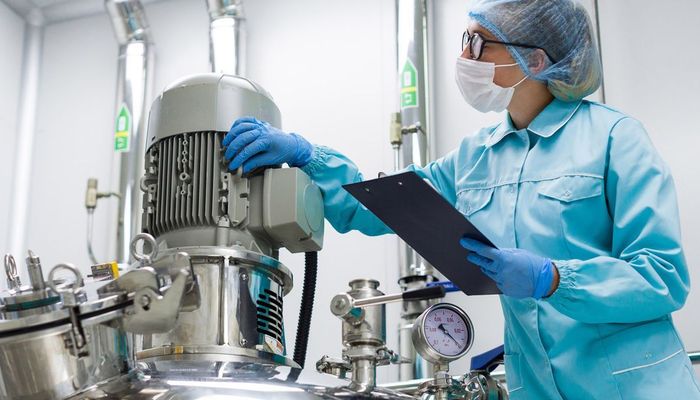
What Does an EMS Monitor?
What you monitor depends on your cleanroom classification, process, product, and regulations. The table below summarizes the four core parameters.
| Parameter | Typical Sensor | Typical Frequency | What an alarm usually means |
| Airborne Particles | Optical particle counter | Continuous, sequential, or periodic, based on risk | Particle count above alert or action level |
| Differential Pressure | Pressure transmitter | Continuous | Pressure relationship lost or unstable |
| Temperature | RTD or digital probe | Continuous | Reading outside the process-defined range |
| Relative Humidity | Capacitive humidity sensor | Continuous | Reading outside the process-defined range |
Airborne Particles
A particle counter draws in a known volume of air and counts particles in specified size ranges. ISO 14644-1 classifies air cleanliness by particle concentration, which is different from general air quality measures such as PM2.5.
Maximum permitted particles per cubic meter (ISO 14644-1:2015)
| ISO Class | ≥0.5 µm | ≥5 µm |
| ISO 5 | 3,520 | 29 |
| ISO 6 | 35,200 | 293 |
| ISO 7 | 352,000 | 2,930 |
| ISO 8 | 3,520,000 | 29,300 |
Differential Pressure
Cleanrooms are usually held at higher pressure adjoining less-clean rooms, so air flows in the intended direction when doors open. EU GMP Annex 1 calls for a positive differential of at least 10 Pa between adjacent rooms of different classification, with doors closed. FDA’s aseptic processing guidance suggests 10 to 15 Pa. Containment applications, such as handling potent compounds, need a different strategy.
Temperature and Relative Humidity
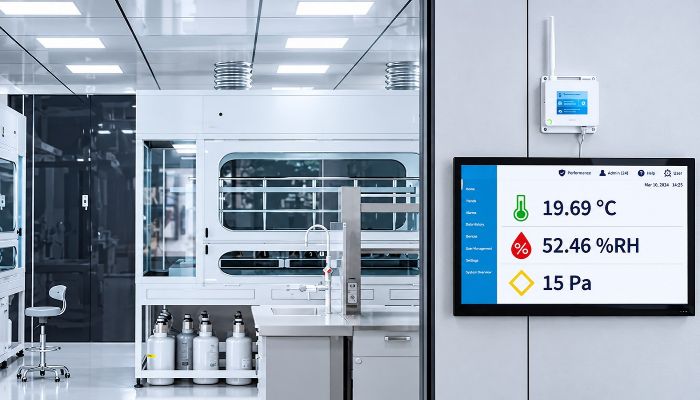
Temperature and humidity affect products, static electricity, condensation, equipment, and operator comfort. There is no universal setpoint. Many facilities work around 20 to 24 °C and 30 to 60% RH, but your process, product, and facility requirements should define your own limits. The EMS then tracks conditions against them.
How Does an EMS Work?
An EMS follows a simple cycle: Measure → Transmit → Record → Compare → Alert → Review
Sensors measure conditions, and the data travels over the facility network to the software. The software records it and compares it with your limits. When a limit is exceeded, it raises an alarm or notification.
The real value is history. You don’t only see the current condition. You can see what happened before, during, and after an event.
Where Should Monitoring Points Go?
Choose monitoring points by risk, not installation convenience. A sensor in an easy-to-reach spot is useless if it doesn’t represent the condition you need to understand.
Look at:
- Critical production areas and exposed products or processes
- Equipment locations and personnel activity
- Material transfer points, doors, and airlocks
- Pressure boundaries and airflow patterns
Airflow visualization (smoke studies) can reveal turbulence and obstructions that aren’t obvious from the room layout, and it helps you pick more representative particle-monitoring locations.
Can Installation Affect Your Data?
Yes. A monitoring system is only as good as the measurements it receives.
For particle monitoring, these factors affect how representative a sample is:
- Probe position and orientation
- Sampling tubing material, length, and bends
- Airflow direction at the probe
- Distance from the monitored area
The probe should collect a representative sample without disturbing critical airflow. Temperature, humidity, and pressure sensors need sensible placement too. A sensor near a heat source won’t represent the room. Plan the EMS during cleanroom design, not afterward.

Continuous vs. Periodic Monitoring
Not every parameter needs the same approach. The right method depends on process risk, classification, and the standards that apply to you.
| Continuous | Periodic or sequential | |
| Best for | Pressure, temperature, humidity, critical particle zones | Lower-risk particle zones |
| Strength | Full history, immediate alarms | Lower cost, fewer instruments |
| Limitation | More data to manage | Events between samples can be missed |
More data is not automatically better. Choose the method that reliably reveals meaningful change.
Classification vs. Routine Monitoring
The two serve different purposes.
| Classification | Routine monitoring | |
| Purpose | Demonstrates air cleanliness under specified test conditions | Tracks performance over time |
| Standard | ISO 14644-1 | ISO 14644-2 |
| Timing | Formal, scheduled tests | Ongoing |
| Conditions | Defined test state | Real operation: people, equipment, material movement, door activity |
A cleanroom can pass classification and still drift during normal production. Routine monitoring shows you what happens between formal tests.
Alert Levels, Action Levels and Alarm Fatigue
Good alarm design uses two tiers:
- Alert level: an early warning, often set from historical data. It tells you a trend may be developing, and you review it.
- Action level: a defined limit that triggers a documented response and investigation.
Alarm fatigue happens when operators receive so many nuisance alarms that real ones get ignored. To reduce it:
- Set alert and action levels from your risk assessment and historical data
- Use short delays for known, harmless events such as brief door openings
- Route alarms to the right people, with clear priority levels
- Review alarm statistics regularly and refine thresholds under change control
If your Grade A or critical zones fall under EU GMP Annex 1, the particle limits are stricter and continuous monitoring is expected during critical processing. Check the current text for your grade and process.
What Happens When the EMS Detects an Excursion?
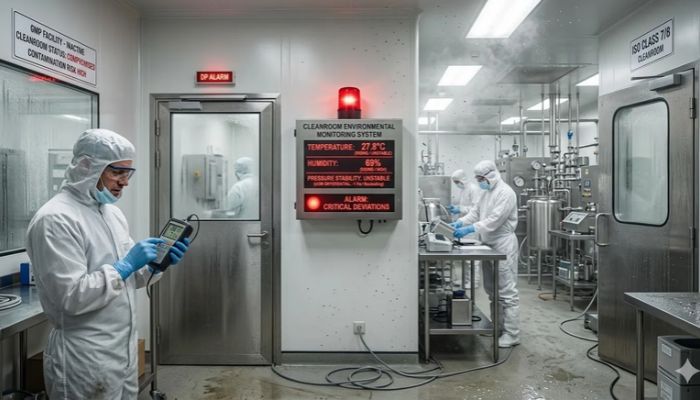
An alarm tells you a limit was reached. It does not tell you why. Say the differential pressure drops. Possible causes include an open door, HVAC changes, maintenance, process conditions, or a sensor or communication fault.
Follow a clear sequence:
Detect → Verify → Assess → Investigate → Correct → Document
Confirm the reading first, then review related measurements and events. A pressure drop that coincides with a door event gives useful context. Several parameters changing together can narrow the investigation. This is why accurate timestamps and complete records matter.

Why Trending Matters
Alarms report single events. Trending reveals changes that develop over time. Watch for:
- Rising alarm frequency
- Repeated deviations at one monitoring point
- Temperature or humidity drift
- Pressure instability
- Changes after maintenance
- Particle increases during specific operations
Review trends by monitoring point and operating condition, because a facility-wide average can hide a local problem. Repeated short pressure deviations at one airlock deserve attention even if the room recovers each time.
Data Integrity: ALCOA+, Audit Trails, and 21 CFR Part 11
For regulated industries, EMS data is a GMP record. It must be trustworthy, and regulators expect it to follow ALCOA+ principles: Attributable, Legible, Contemporaneous, Original, Accurate, plus Complete, Consistent, Enduring, and Available.
In practice, your EMS software should provide:
- Audit trails that record who changed what, when, and why, including limit changes and alarm acknowledgments
- User access control with unique logins and defined roles
- Electronic signatures where required, in line with FDA 21 CFR Part 11 and EU GMP Annex 11
- Protected storage and backup so records stay complete and retrievable for their required retention period
- Validation of the system for its intended use, plus change control for updates
Ask a supplier to show these features working, not just listed in a brochure.
What Happens If the EMS Goes Offline?
The monitoring system can fail too, through sensor communication loss, network outages, server failures, database problems, or power interruptions.
Design for failure according to how critical the application is:
- Communication-loss alarms
- Local data buffering at the sensor or controller
- Backup power and protected data storage
- Defined recovery procedures
A communication failure should never look like a normal reading. For critical cleanrooms, decide in advance how you will assess a monitoring gap if production continues while EMS data is unavailable.
Which Standards Apply?
Requirements depend on your industry, process, product, and location.
| Standard | What it covers |
| ISO 14644-1 | Cleanroom classification by airborne particle concentration |
| ISO 14644-2 | Monitoring plan, risk assessment, methods, calibration, deviation response, and plan review |
| EU GMP Annex 1 | Sterile manufacturing: grades A to D, particle limits, viable and non-viable monitoring, contamination control strategy |
| FDA Aseptic Processing Guidance | Environmental monitoring expectations for aseptic processing in the US |
| 21 CFR Part 11 / EU Annex 11 | Electronic records, signatures, and computerized systems |
Base your EMS requirements on the standards that actually apply to your facility.
How to Select Your EMS
Use these questions when comparing systems and suppliers.
How Do I Choose Monitoring Points?
Base them on a documented risk assessment and airflow studies. Every point should have a clear purpose.
Which Parameters and Instruments Do I Need?
Match them to your classification, process, and regulatory requirements. Confirm calibration requirements and intervals for each instrument.
How Should I Set Alarm Limits?
Define both alert and action levels, with documented rationale and a plan to review them.
Does the Software Meet Data Integrity Expectations?
Check audit trails, access control, electronic signatures, backup, and validation support.
How Will the System Handle Failures?
Ask about communication-loss alarms, data buffering, backup power, and recovery procedures.
Can It Grow With My Facility?
Check whether you can add sensors, rooms, and users without redesigning the system.
Who Supports It After Installation?
Look for commissioning, training, calibration, and long-term service.
EMS Planning Checklist
Before selecting or designing an EMS, confirm you have:
- Identified the conditions that need monitoring.
- Defined the applicable standards and regulations.
- Selected monitoring points based on process risk.
- Chosen suitable sensors and instruments.
- Determined monitoring frequencies.
- Established alert and action levels.
- Determined calibration requirements.
- Planned how alarms will be investigated.
- Established data storage, trending, and data integrity controls.
- Planned for network, sensor, server, or power failures.
- Described how system changes will be controlled.
- Set a schedule to review the monitoring strategy.
If you can’t explain what a sensor measures, why it is there, and what your team should do when it alarms, reconsider that part of the design.
Wrapping Up
A good cleanroom monitoring system is not the one with the most sensors. It is the one that measures the right conditions in the right places, records how they change over time, alerts you when something goes wrong, and gives you reliable data to find the cause.
Airflow, pressure, temperature, humidity, and room layout all affect each other. That is why they work best when planned together.
If you have any questions about cleanroom environmental monitoring or need a cleanroom solution for your facility, the Sunnyda Clean Room team is here to help. From cleanroom construction and HVAC to pressure control and environmental monitoring, we can help you plan a system that works together from day one.
Frequently Asked Questions
What is a cleanroom environmental monitoring system?
It’s a system of sensors, software, and alarms that measures and records conditions such as particles, pressure, temperature, and humidity in a cleanroom.
What should a cleanroom EMS monitor?
At minimum, the parameters your process and regulations require. Commonly, that means airborne particles, differential pressure, temperature, and relative humidity.
What differential pressure should a cleanroom maintain?
EU GMP Annex 1 specifies at least 10 Pa between adjacent rooms of different classification, and FDA guidance suggests 10 to 15 Pa. Your own design may require more.
What is the difference between alert and action level?
An alert level is an early warning to review a possible trend. An action level is a defined limit that triggers a documented investigation and response.
How often should particles be monitored?
It depends on classification, process risk, and regulations. Critical septic zones are typically monitored continuously. Other areas follow a risk based planned.
Is cleanroom classification the same as monitoring?
No. Classification demonstrates cleanliness under test conditions. Monitoring tracks performance during normal operation.
You may also find these blog posts useful
Sterile vs. Clean in a Cleanroom: What’s the Difference?

